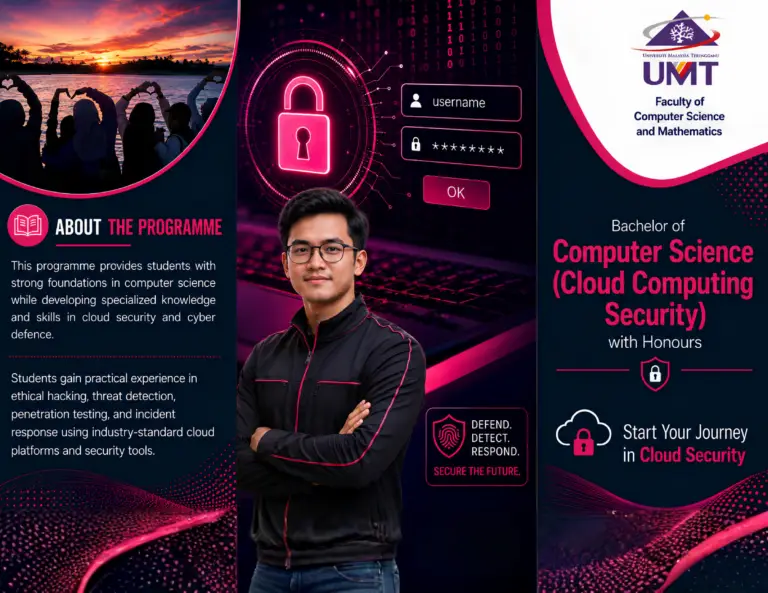
The Bachelor of Computer Science (Cloud Computing Security) with Honours is offered to both local and international students, particularly STPM leavers, Matriculation students, Diploma graduates, and those with equivalent qualifications. This programme provides students with strong foundations in computer science while developing specialized knowledge and skills in cloud security and cyber defence. The curriculum integrates theoretical knowledge with practical training to strengthen technical competencies, critical thinking, problem-solving, communication, leadership, teamwork, and professional ethics. Students gain hands-on experience in ethical hacking, threat detection, penetration testing, incident response, and cloud infrastructure security using industry-standard cloud platforms and security tools. Graduates of this programme have strong potential for high-demand careers in the cybersecurity industry.
After five (5) years of successfully completing the program, our graduates will be:
PEO1 : Cloud Security Analyst who is able to apply knowledge (LO1), technical (LO3) and digital skills (LO6) in the field of cloud security in line with industry needs.
PEO2 : Cloud Security Analyst who has good interpersonal (LO4) and communication skills (LO5) to interact with stakeholders.
PEO3 : Cloud Security Analyst who upholds ethics and professional practices (LO11) in maintaining integrity.
PEO4 : Cloud Security Analyst who has leadership skills (LO8) and is competent in solving computing problems (LO2) using scientific and numeracy skills (LO7).
PEO5 : Cloud Security Analyst who has autonomous learning skills (LO9) and entrepreneurial thinking (LO10) for personal and career development in the field of cloud security.
This course covers the basic concept of corruption, including the value of integrity, anti-corruption, forms of corruption, abuse of power in daily activities and organizations as well as waysto prevent corruption. Cases related to corruption are discussed. Teaching and learning methods are implemented in the form of ‘experiential learning’ through individual and group activities. At the end of this course, students are able to understand the practice of integrity, the concept of corruption, anti-corruption, abuse of power as well as the prevention of corruption in society and organizations.
This course gives students an exposure to the basic concepts of entrepreneurship. Students will do learning activities that lead to building an entrepreneurial mindset as an initial preparation for a future career. This course provides an exposure to students on knowledge in entrepreneurship. It also gives students the opportunity to apply the knowledge obtained from their respective fields. In addition, the course aims to apply the entrepreneurial mind sets into their life after graduation.
This course is offered to international students who want to learn the fundamentals of the Malay Language to be used in daily conversations either in formal or informal settings. Students will also be trained to read simple reading materials and to write simple essays. Other than that, students will also be exposed to aspects of the Malaysian/Malay culture, through video presentations and field trip.
This course discusses the concepts of discrete mathematics and how to use them in computer science environment. It covers the fundamentals topics such as the principle of counting, fundamentals of logic, set, mathematical induction, relations and functions, recurrence relations, and graphs.
.
.
.
This course introduces database concepts (goals of DBMS, relationships, physical and logical organization, schema and subschema); data models, normalisation (until BCNF), canonical schema and data independence; data description language; query facilities, query functions; design and translation strategies; and data integrity and reliability.
This course offers the knowledge of integrating a basic concept of Human Computer Interaction (HCI) with Web Design. This course also, practically, will expose students to the two (2) core technologies for building web sites which are Hypertext Markup Language (HTML) and Cascading Style Sheets (CSS). Before the end of this course, students will develop a simple web site by applying the principles and methods to the design of user-centred web sites.
This course introduces operating system concepts as well as discusses the mechanisms necessary for the protection and security of computer systems. Major topics in operating systems cover process, thread and multiprogramming concepts (scheduling, synchronization, deadlock etc.), memory management, storage management and file management. Students will also be exposed to the current technologies in operating system through a case study.
This course introduces cyber security especially Internet. The usage of cryptography technique will be discussed. This course also introduces to student about form of threat to the internet. Several defence applications such as firewall and network analysis tools will be introduced to the student.
This course exposes students the architecture, structure, functions and components of the Internet and other computer networks. By the end of the course, students will be able to build simple LANs, perform basic configurations for routers and switches, and implement IP addressing schemes.
This course exposes students the architecture, structure, functions and components of the Internet and other computer networks. By the end of the course, students will be able to build simple LANs, perform basic configurations for routers and switches, and implement IP addressing schemes.
This course exposes students the architecture, structure, functions and components of the Internet and other computer networks. By the end of the course, students will be able to build simple LANs, perform basic configurations for routers and switches, and implement IP addressing schemes.
l.Obtain at least a Grade C in TWO (2) STPM subjects, comprising: i) Mathematics T. ii) Physics / Chemistry / Biology / Sports Science / Visual Arts / Information and Communication Technology.
2.Obtain at least a Grade C in any TWO (2) STPM subjects, AND obtained at least a Grade C in Additional Mathematics at the SPM level.
3.Obtain at least a Grade C in any TWO (2) STPM subjects,
AND obtained at least a Grade C in the following TWO (2) SPM subjects: i) Mathematics, ii) ONE (1) Science,
Technology. or Engineering subject.
Obtained at least a Grade C in TWO (2) subjects at the STPM level:
i. Mathematics T
ii. Physics / Chemistry / Biology / Sports Science / Visual Arts / Information and Communication Technology
Obtained at least a Grade C in any TWO (2) subjects at the STPM level, AND obtained at least a Grade C in Additional Mathematics at the SPM level.
Obtained at least a Grade C in any TWO (2) subjects at the STPM level, AND obtained at least a Grade C in TWO (2) subjects at the SPM level:
i. Mathematics
ii. One of the subjects of Science, Technology or Engineering
1. Obtain at least a Grade C in Additional Mathematics at the SPM level.
2.Obtain at least a Grade C in the following TWO (2) SPM subjects: i) Mathematics. ii) ONE (1) Science. Technology, or Engineering subject.
OR
OR
OR
AND
Candidates must meet ONE of the following requirements:
Pass a Diploma in Science and Technology with a minimum CGPA of 2.75 and meet ONE (1) of the following conditions:
1. Obtain at least a Grade C in Additional Mathematics at the SPM level.
2. Obtain at least a Grade C in the following TWO (2) SPM subjects: i) Mathematics, ii) ONE (1) Science. Technology, or Engineering subject.
.
OR
OR
OR
AND
Candidates must meet ONE of the following requirements:
Obtained at least JAYYID in any TWO (2) subjects at the STAM level, AND obtained at least a Grade C in Additional Mathematics at the SPM level.
Obtained at least JAYYID in any TWO (2) subjects at the STAM level, AND obtained at least a Grade C in TWO (2) subjects at the SPM level:
i. Mathematics
ii. One of the subjects of Science, Technology or Engineering
Our International Centre office will be happy to advise prospective students on entry requirements. See our International Centre website for further information for international students.
Local | International | Additional Costs |
RM 7,950 | USD 7,220 | Find out more about accommodation and living costs, plus general additional costs that you may pay when studying at UMT. |
Government funding
You may be eligible for government finance to help pay for the costs of studying. See the Government’s student finance website
Scholarships are available for excellence in academic and co-curricular activities, and are awarded on merit. For further information on the range of awards available and to make an application see our scholarships website.